
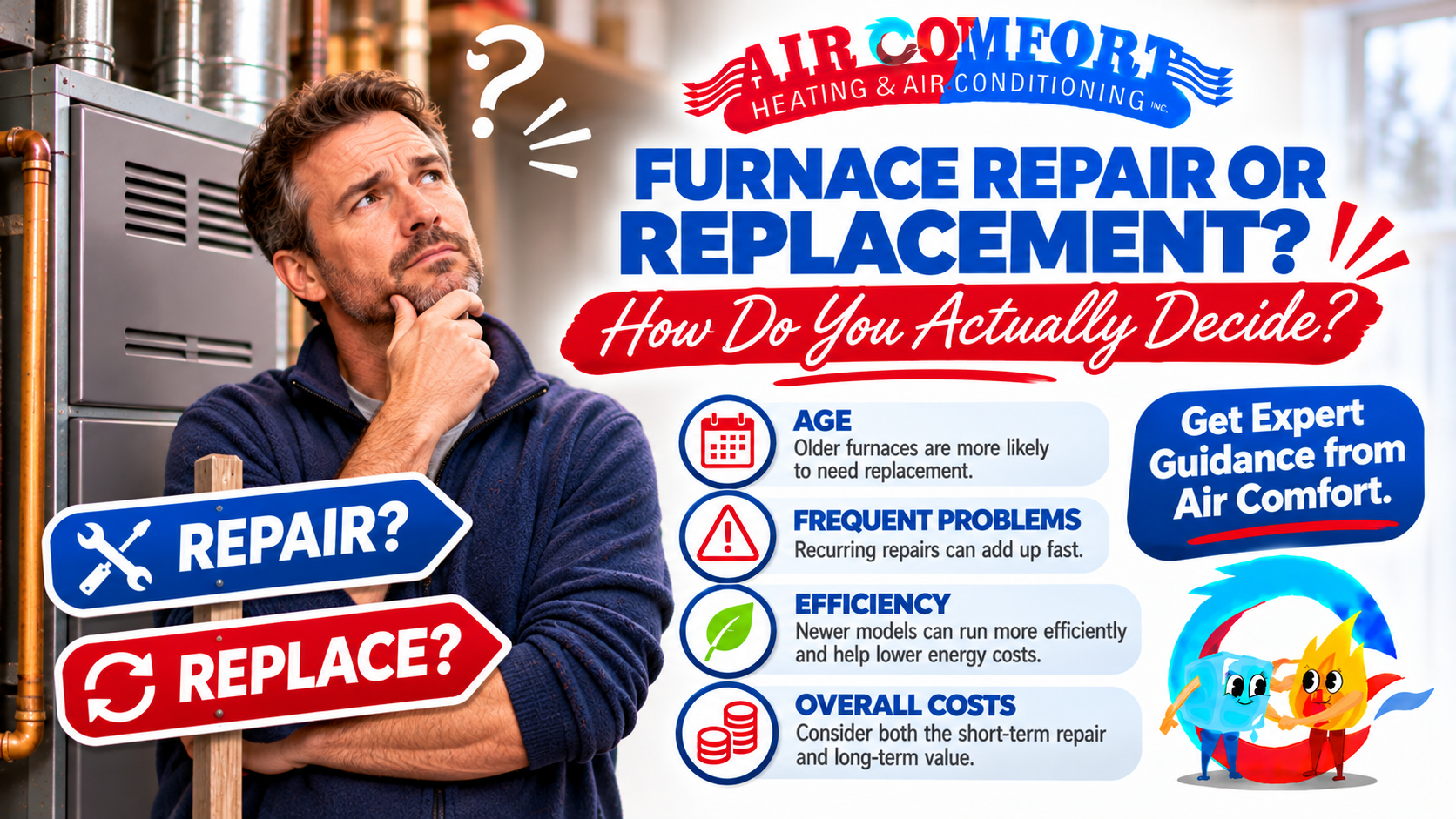
Your furnace needs a repair.
Not a tiny repair.
One that makes you stare at the estimate for a while.
Now the question becomes:
Do we repair this furnace—or stop putting money into it?
There is no honest universal formula.
There is a better way to think through the decision.
Start With What Actually Failed
A relatively routine electrical component on an otherwise healthy furnace is very different from:
- significant heat-exchanger damage
- major blower failure
- repeated combustion problems
- multiple major component concerns
Understand the specific repair before deciding what the entire furnace is worth.
Then Consider Age
Age matters because an older furnace has more accumulated wear and fewer expected years ahead of it than new equipment.
But calendar age alone is not enough.
An older furnace is not automatically a bad furnace. A newer furnace is not automatically worth every repair.
Look at Repair History
One repair after years of reliable operation is different from:
December repair.
February repair.
October repair.
Now another estimate.
Patterns matter.
What Condition Is the Rest of the Furnace In?
Before approving a major repair, ask what is known about:
- blower condition
- heat exchanger
- controls
- combustion performance
- venting
- overall equipment condition
No technician can predict the exact next failure.
But current condition gives the repair decision context.
How Important Is Reliability to Your Household?
Heating reliability has a different meaning in Minnesota than AC reliability in a mild climate.
A household with young children, older adults, medical concerns or frequent travel may reasonably place additional value on winter reliability.
Another homeowner may prefer to repair older equipment as long as the repairs remain economically reasonable.
Neither strategy is automatically wrong.
Does the Existing Furnace Actually Serve the Home Well?
Even when operating normally, ask:
- Are rooms comfortable?
- Does the system short cycle?
- Is it unusually loud?
- Does the home have chronic airflow problems?
- Does the furnace keep up during cold weather?
Replacement can be an opportunity to solve broader comfort problems—but only if those issues are considered during system design.
Compare Repair Cost With Replacement Cost
There is no magic percentage that makes the decision for every homeowner.
But context matters.
A relatively small repair on otherwise healthy equipment can strongly favor repair.
A major repair on aging equipment with several other concerns creates a different decision.
Repair
What failed?
What does the repair cost?
What does it restore?
What known risks remain?
Replace
What system is proposed?
Why was it selected?
What improves?
What warranty and future options come with it?
What Would Replacement Actually Improve?
Compare more than equipment age.
Replacement may potentially change:
- fuel efficiency
- heating stages
- blower operation
- noise
- temperature consistency
- controls
- warranty coverage
- future heat-pump compatibility
What About the Air Conditioner?
Your furnace blower commonly serves the central cooling system too.
If the AC is also aging, understand how today's furnace choice affects tomorrow's cooling or heat-pump replacement.
You do not automatically need to replace both systems.
You should understand the full HVAC plan.
Could a Heat Pump Be Part of the Next System?
If replacement is genuinely being considered, compare the available configurations for the home.
That may include conventional furnace and AC equipment or a furnace paired with a heat pump in a dual-fuel strategy.
The replacement does not automatically need to copy exactly what was installed years ago.
Make the Decision With Information
Air Comfort's job is to explain:
what failed, what repair costs, what condition remains and what replacement would change.
Then the homeowner can make the decision that fits the house, budget and tolerance for future repair risk.
Repair or replace?
We can help you understand both paths without turning the conversation into a pressure-filled sales decision.
Frequently Asked Questions
Is an older furnace always better to replace than repair?
No. The specific failure, repair cost, overall condition, reliability and homeowner priorities should all be considered.
Should I replace a furnace before it completely fails?
Proactive replacement can make sense when condition and reliability concerns justify it, but functioning equipment does not need replacement solely because of age.
Should I think about my AC when replacing the furnace?
Yes. The systems often share indoor airflow components, and today's furnace selection can affect future cooling or heat-pump options.
