
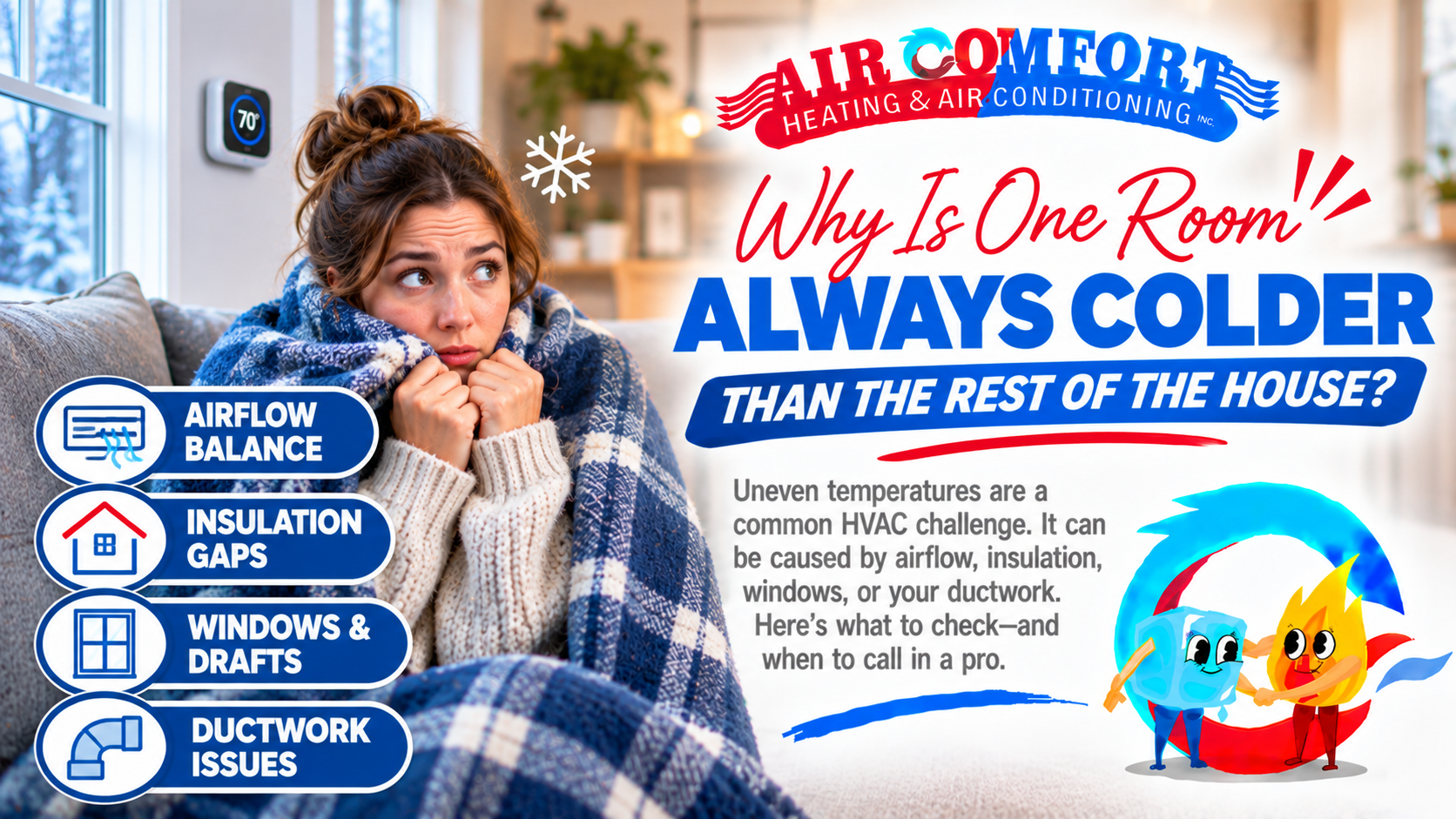
The thermostat says 70.
The living room feels comfortable.
The kitchen feels comfortable.
One bedroom down the hall apparently opted out of heating season.
When one room consistently stays colder than the rest of the home, the furnace is not automatically the problem.
If most of the house is comfortable, the issue may be local to that room or the ductwork serving it.
Start With the Supply Register
Check the obvious first.
Is the vent:
- open?
- covered by furniture?
- blocked by a rug?
- behind heavy curtains?
Then compare airflow with nearby rooms.
Is Airflow Weaker in the Cold Room?
If the room has dramatically less airflow, possible causes can include:
- duct restriction
- balancing issue
- damaged or disconnected duct
- long duct run
- damper position
- duct leakage
That is more useful information than simply turning the thermostat higher.
Don't Forget Return Air
Supply air needs to enter the room.
Air also needs a path back toward the HVAC return system.
If a bedroom becomes dramatically colder whenever the door is closed, return-air pathways may be part of the problem.
Windows Can Make a Room Feel Colder
A room may lose more heat because of:
- large windows
- older glass
- air leakage
- window orientation
Cold glass surfaces can also make occupants feel less comfortable even when the measured air temperature is not dramatically different.
Room Location Matters
Corner rooms have more exterior wall exposure.
Rooms over garages can have unique insulation conditions.
Additions may have been built differently from the original house.
The furnace has to overcome the specific heat loss of that room.
Look for a Pattern
Ask:
- Is the room coldest on windy days?
- Only at night?
- Only when the door is closed?
- Only during extreme weather?
- Has it always been this way?
Patterns can help separate airflow problems from building-envelope problems.
Should You Close Vents in Warmer Rooms?
A small balancing adjustment may sometimes be appropriate.
Aggressively shutting down half the duct system trying to force heat toward one bedroom is not a good long-term strategy.
If one room needs substantially more airflow, solve the underlying problem.
Would a Thermostat Sensor Help?
Possibly.
Some thermostat systems can use remote sensors to consider temperature in another room.
But a sensor cannot manufacture airflow that never reaches the room.
Would a Ductless System Help?
For certain additions, bonus rooms or difficult spaces, a ductless heat pump may sometimes provide independent heating and cooling.
That should come after understanding why the existing room is difficult to condition.
Don't Overheat the Entire House for One Bedroom
If the thermostat needs to be set to 76 just to get one bedroom to 68, the thermostat setting is not solving the real problem.
One room never comfortable?
Air Comfort can evaluate airflow, ductwork and heating performance to help identify why.
Frequently Asked Questions
Why is one bedroom colder even though my furnace works?
The room may have insufficient supply airflow, limited return airflow, higher heat loss or a duct-distribution issue.
Can keeping a bedroom door closed affect heating?
It can in some homes if closing the door limits the room's return-air pathway.
Will a bigger furnace fix one cold room?
Not necessarily. Increasing furnace capacity does not automatically correct a duct, airflow or insulation problem affecting one room.
