
Blog - Air Comfort Heating & Air Conditioning
How Many Repairs Are Too Many for an Older AC?
There is no universal rule saying:
HVAC systems are mechanical equipment.
Parts eventually fail.
A repair does not automatically mean the system is finished.
But repeated repairs can eventually change the conversation.
One Repair Is a Moment
Several repairs are a pattern.
Now imagine the same older system has needed:
Add Up What You've Actually Spent
Homeowners tend to evaluate today's repair by itself.
Instead, look backward.
Looking at the total investment gives you better context for the next decision.
Are the Repairs Related?
This matters.
Repeated symptoms may deserve a deeper look instead of another isolated repair.
What Major Components Are Still Original?
An older system that has already had several repairs may still contain:
How Reliable Does Your AC Need to Be?
Different households tolerate risk differently.
Reliability may carry more weight in homes with:
Others may be comfortable continuing to repair older equipment until a major failure occurs.
Repairs Can Become Emotionally Expensive Too
There is a cost that does not appear on the invoice.
Don't Replace Just Because You're Annoyed
Frustration can also lead homeowners to replace equipment prematurely.
Before doing that, make sure the replacement will actually address the issue.
Look at the Next Five Years, Not Just Today
Ask:
Then compare:
Air Comfort Will Help You See the Pattern
We do not need a predetermined number of repairs to tell you what to do.
We want to understand:
Let's Look at the Pattern, Not Just Today's Breakdown
Air Comfort Heating & Air Conditioning helps homeowners throughout Anoka County, the North Metro and surrounding Minnesota communities evaluate repeated AC repairs, equipment condition, reliability concerns and replacement options.
There is no magic repair count. The useful question is whether continuing to invest in the current system still makes sense for your home, comfort needs and budget.
Repeated AC Repair Questions
How many AC repairs mean I should replace it?
There is no fixed number. Repair cost, equipment age, severity, frequency and overall system condition all matter.
Should I keep receipts from HVAC repairs?
Yes. Repair history can be very useful when deciding whether additional investment in the existing system still makes sense.
Does replacing an AC eliminate every future HVAC repair?
No mechanical system is maintenance-free or failure-proof. New equipment does, however, reset equipment age and typically comes with new-component warranty coverage.
When Is an AC Repair No Longer Worth It?
Your AC can be repaired.
That does not automatically mean it should be repaired.
On the other hand, an older air conditioner does not automatically need replacement every time something breaks.
The right answer depends on what failed, what the repair costs, the condition of the rest of the system and what matters most to the homeowner.
Start With What Actually Failed
A small electrical repair on an older system is different from:
Understand the specific failure first.
How Old Is the System?
Age matters because it helps provide context for what may happen after today's repair.
What Does the Repair Cost Compared With Replacement?
Homeowners should know both numbers when the repair is significant.
Not because replacement automatically wins.
Because you need context.
What Else Is Wrong?
This is one of the biggest questions.
Suppose today's failed component can be repaired.
What is the condition of the rest of the system?
How Many Repairs Has It Needed Recently?
One failure after ten uneventful years is not the same as:
Does the AC Still Meet Your Comfort Needs?
Maybe the equipment can be repaired—but even when operating normally it:
Replacement may provide an opportunity to solve larger comfort problems.
How Long Do You Plan to Stay in the Home?
That can influence how you evaluate the investment.
A homeowner planning to stay another 15 years may value:
differently from someone preparing to move soon.
Don't Use a Fake Formula as the Entire Decision
You may see internet rules such as:
“Equipment age × repair cost = replace.”
Actual equipment condition and homeowner priorities matter.
Ask for Both Paths
For a significant failure, Air Comfort believes homeowners should understand both options.
- What does it cost?
- What gets fixed?
- What risks remain?
- What does it cost?
- What changes?
- What warranty is included?
- What comfort improvements are expected?
Repair or Replace Should Be a Decision, Not a Sales Script
The right choice can depend on the homeowner's budget, priorities and tolerance for future repair risk.
Let's Put the Repair and Replacement Options Side by Side
Air Comfort Heating & Air Conditioning helps homeowners throughout Anoka County, the North Metro and surrounding Minnesota communities understand major AC repairs, equipment condition, replacement options and the tradeoffs between them.
The goal is not to make an older system sound hopeless—or make every repair sound worthwhile. It is to give you enough information to make a decision that fits your home, comfort expectations and budget.
AC Repair or Replacement Questions
Is it worth repairing a 15-year-old AC?
It depends on the failure, repair cost, overall equipment condition and repair history. Age alone is not enough to make the decision.
Should I replace an AC after one breakdown?
Not necessarily. Some failures involve relatively routine, replaceable components. The specific failure and overall system condition matter.
What should I ask before approving a major AC repair?
Ask what failed, what the repair solves, what other major components look like, what risks remain and what replacement would cost.
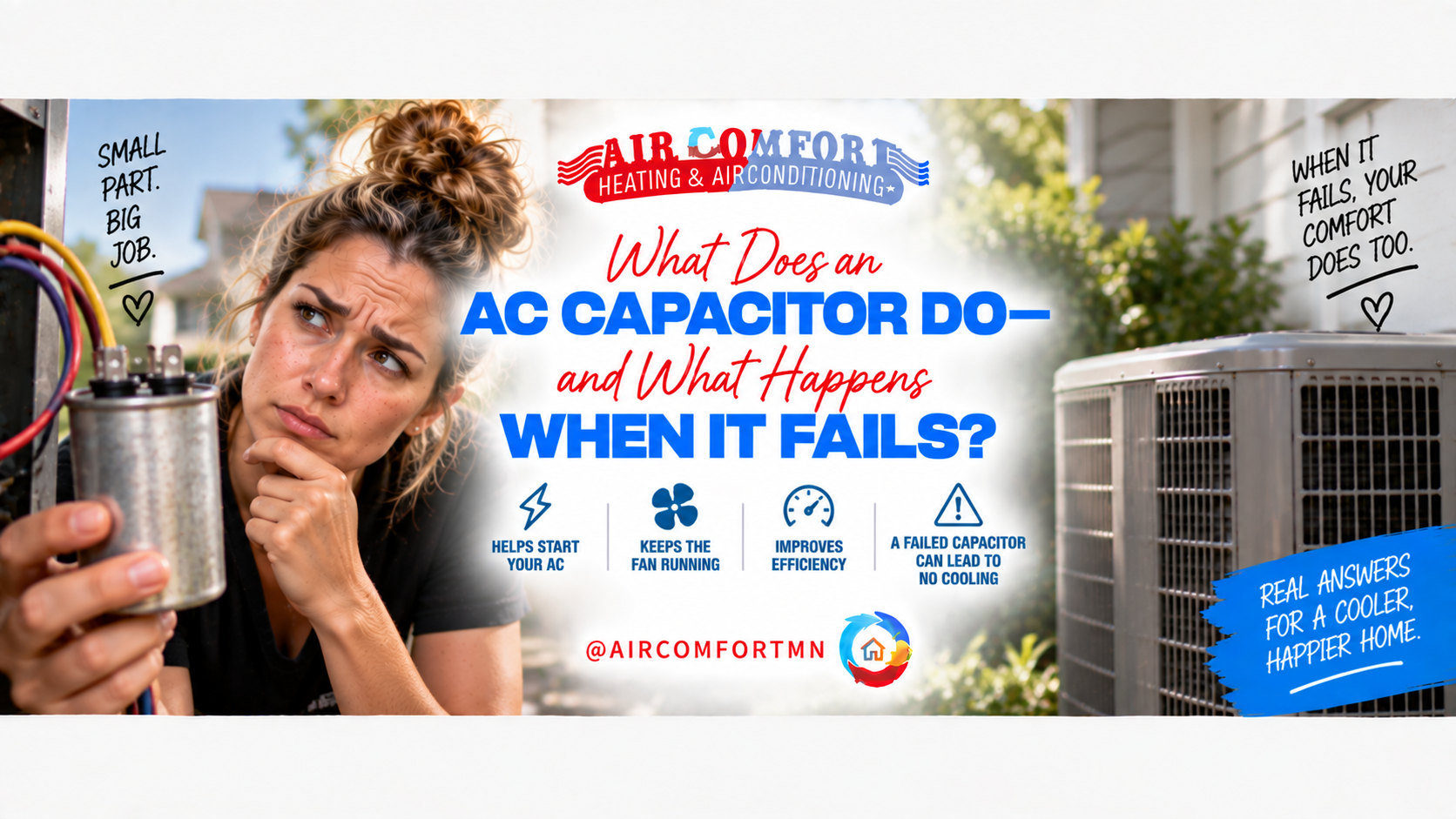
What Does an AC Capacitor Do—and What Happens When It Fails?
The air conditioner is trying to start.
You hear a hum.
Maybe a click.
Maybe the outdoor fan is not moving.
And somewhere during the service call, the technician says:
“The capacitor failed.”
Great.
What's a capacitor?
When it weakens or fails, the system may struggle to start, stop cooling or behave differently than normal.
A Capacitor Helps Electrical Motors Operate
Residential air conditioners contain motors and a compressor that need electrical assistance to start and operate.
Capacitors store and release electrical energy to help those components function.
Depending on the system, a capacitor may serve:
Why Do Capacitors Fail?
They are electrical components operating in demanding conditions.
Outdoor condensers experience:
What Might a Homeowner Notice?
Possible symptoms include:
Do not diagnose a capacitor solely by sound.
Please Don't Push the Fan With a Stick
Yes, the internet tells people to do this.
No, we do not recommend it.
Capacitors Can Store Electrical Charge
This deserves emphasis.
That is one reason capacitor diagnosis and replacement should be handled by trained professionals.
Is a Capacitor Failure a Major Repair?
Often it is a relatively straightforward component repair compared with replacing a compressor or entire air conditioner.
But the technician should still determine:
- 01 Did the capacitor actually fail?
- 02 Is the connected motor healthy?
- 03 Did another electrical issue contribute?
- 04 Does the equipment operate normally after replacement?
Should Capacitors Be Replaced Preventively?
There is no universal rule that every capacitor should automatically be replaced simply because it has reached a certain birthday.
Why Summer Exposes Weak Electrical Components
Hot weather increases AC runtime and the number of hours components operate under load.
A weak part that survived mild spring weather may finally fail during sustained heat.
Ask What Was Tested
If a technician recommends replacing a capacitor, homeowners can reasonably ask:
Air Comfort helps homeowners understand the repair rather than simply handing them a part name and an invoice.
Let's Test the Electrical System Before Guessing at the Part
Air Comfort Heating & Air Conditioning helps homeowners throughout Anoka County, the North Metro and surrounding Minnesota communities diagnose capacitor failures, fan problems, compressor-starting issues and other AC electrical problems.
A failed capacitor may be a straightforward repair, but the right diagnosis includes verifying the component, checking what it serves and confirming normal operation afterward.
AC Capacitor Questions
Can an AC run with a bad capacitor?
A weak or failed capacitor can prevent components from starting or operating correctly.
Can I replace an AC capacitor myself?
Capacitors and HVAC electrical circuits can present serious electrical hazards. Professional diagnosis and replacement are recommended.
Does a failed capacitor mean I need a new AC?
No. A capacitor is a replaceable component. The overall equipment condition determines whether other recommendations are appropriate.
Why Does My AC Run All Night?
You go to bed.
The AC is running.
You wake up at 2 AM.
Still running.
Morning arrives. Surely it took a break at some point?
Maybe.
Maybe not.
Long overnight cooling cycles can happen during hot, humid weather.
Runtime alone does not tell you whether the AC is operating normally or falling behind.
Night Does Not Always Mean the House Immediately Cools
The sun goes down.
The house does not instantly release all the heat it absorbed during the day.
Your:
may continue releasing stored heat for hours.
Humidity Can Keep the System Working
Nighttime temperatures may drop while humidity remains high.
The air conditioner continues removing moisture while maintaining temperature.
Bedroom Temperature May Be Different From Thermostat Temperature
Your thermostat may be downstairs.
Your bedroom may be upstairs.
If you lower the thermostat at night trying to make an upstairs bedroom comfortable, the system may have to run much longer.
Did You Change the Temperature at Bedtime?
Suppose your daytime setting is 76.
At 10 PM you change it to 68.
That can take substantial time.
Variable Systems May Intentionally Run Longer
Some modern HVAC systems are designed to operate for long periods at reduced capacity.
That can support:
When Is It Concerning?
Look beyond whether the equipment is simply running.
Watch for:
Could the AC Be Undersized?
Potentially.
But do not make that conclusion from runtime alone.
Properly sized equipment may run for extended periods during peak conditions.
Could the AC Be Dirty or Losing Performance?
Also possible.
Several conditions can affect how much cooling capacity the system can deliver.
Focus on the Outcome
Air Comfort can help distinguish normal summer workload from a cooling system that is falling behind.
Let's Determine Whether It's Normal Runtime or Lost Performance
Air Comfort Heating & Air Conditioning helps homeowners throughout Anoka County, the North Metro and surrounding Minnesota communities evaluate long AC runtimes, humidity, airflow, room balance and cooling-system performance.
Long overnight operation is not automatically a problem. But if the system runs continuously while the house gets warmer, stickier or less comfortable, that deserves a closer look.
Overnight AC Runtime Questions
Is it bad for the AC to run all night?
Not automatically. Long cycles can be normal depending on weather, equipment type and cooling demand.
Why does my AC run more at night when I lower the thermostat?
A large nighttime temperature change requires the system to remove additional heat before reaching the new setting.
Should the AC shut off eventually?
Traditional systems normally cycle, while some variable systems intentionally run for long periods at lower capacity.
Can Ceiling Fans Lower My AC Bill?
Yes—but not because a ceiling fan makes the room colder.
That distinction matters.
A ceiling fan primarily makes people feel cooler by moving air across the skin.
That can allow some homeowners to remain comfortable at a slightly higher thermostat setting.
The U.S. Department of Energy describes the same basic principle: ceiling fans create a wind-chill effect on people rather than directly reducing room temperature.
Fans Cool People
Imagine two identical bedrooms.
Both are 75 degrees.
The thermometer may read the same.
Fans Do Not Remove Heat From the House
An air conditioner transfers heat out of your home.
A ceiling fan does not.
Turn Fans Off in Empty Rooms
Because fans primarily improve human comfort, there is usually no reason to keep one spinning in a room nobody occupies.
Can You Raise the Thermostat?
Possibly.
If moving air makes you comfortable at 74 instead of 72, then the AC has less temperature difference to maintain.
How much difference that makes depends on:
What Direction Should the Fan Turn?
Many ceiling fans are configured so summer operation pushes air downward toward occupants.
But fan designs vary.
That outcome matters more than relying exclusively on a clockwise-versus-counterclockwise shortcut.
Ceiling Fans Can Help Upstairs Bedrooms
This can be especially useful in bedrooms that feel warm at night.
They Do Not Solve High Humidity
A fan can make humid air feel better against your skin.
It does not remove moisture.
Use Fans as Part of the Comfort Strategy
Think:
Air Comfort helps Minnesota homeowners understand what each part of their comfort system actually does—without pretending every solution requires new HVAC equipment.
Let's Figure Out Whether It's Temperature, Humidity or Airflow
Air Comfort Heating & Air Conditioning helps homeowners throughout Anoka County, the North Metro and surrounding Minnesota communities understand cooling performance, humidity, airflow and room-to-room comfort.
Ceiling fans can improve how a room feels. If the house still struggles to stay comfortable, the underlying issue may involve the HVAC system or the home itself.
Ceiling Fan & AC Questions
Do ceiling fans actually lower room temperature?
No. They primarily improve comfort through air movement across people rather than directly reducing room temperature.
Should I leave fans running when nobody is home?
Usually not. Their primary benefit is making occupants feel cooler.
Can fans help reduce air-conditioning use?
They may allow you to stay comfortable at a higher thermostat setting, which can reduce cooling demand.
Should I Turn My AC Up When I Leave for the Weekend?
You're leaving for the lake.
Nobody will be home.
So why cool an empty house to 72?
Fair question.
You can usually raise the thermostat while you're away.
Completely shutting cooling down during hot, humid weather may not be the best approach for every home.
Your AC Controls More Than Temperature
Cooling also removes moisture.
If you completely shut cooling down for several hot and humid days, indoor temperature and humidity can rise.
That can affect:
How Much Should You Raise It?
There is no perfect number for every home.
A moderate increase can reduce cooling demand without letting the house become excessively hot or humid.
Consider:
Smart Thermostats Make This Easier
A programmable or smart thermostat can let the home run warmer while you're away and begin recovering before you return.
Don't Set It Extremely High Just to Save a Few Dollars
If the thermostat normally sits at 72 and you raise it dramatically, the AC may have a large amount of heat and moisture to remove when you return.
During very hot conditions, recovery can take time.
What About Pets?
Pets change the answer.
Indoor animals still need safe temperatures.
Should You Turn the AC Completely Off?
For a short summer trip, many homeowners are better served by raising the thermostat instead of shutting cooling down completely.
There can be exceptions.
Every home and trip is different.
Before You Leave
Do a quick check:
- 01 Check the filter and replace it if needed.
- 02 Make sure the thermostat is programmed correctly.
- 03 Close windows.
- 04 Secure exterior doors.
- 05 Position blinds or shades appropriately.
- 06 Make sure the outdoor AC area is clear.
- 07 Check that condensate drainage looks normal.
Coming Home to a Hot House?
Do not set the thermostat to 60 because you want 72 quickly.
Set the desired temperature and allow the system to recover.
Vacation Thermostat Advice Should Fit the House
Air Comfort helps Minnesota homeowners balance comfort, efficiency and real-world HVAC operation without turning thermostat advice into a rigid rulebook.
Use a Setback That Makes Sense for Your Home
Air Comfort Heating & Air Conditioning helps homeowners throughout Anoka County, the North Metro and surrounding Minnesota communities make practical decisions about thermostat settings, humidity, cooling performance and summer comfort.
If your home takes an unusually long time to recover after a normal temperature setback, or cannot reach the set point at all, the issue may be more than the vacation setting.
Vacation AC Questions
Should I turn my AC off when I leave for vacation?
A moderate temperature setback is often more practical during summer because cooling also helps manage indoor moisture.
Does setting the thermostat higher save energy?
Reducing cooling demand while the home is unoccupied can reduce energy use.
Should I cool the house before I arrive home?
A programmable or smart thermostat can begin recovery in advance so you return to a more comfortable temperature.
Can Summer Storms Damage Your Air Conditioner?
Minnesota summer weather can go from:
Your outdoor air conditioner is built to live outside.
Rain itself is not usually a problem.
But severe storms can create conditions that are worth paying attention to.
Your Outdoor AC Is Designed for Weather
First, don't panic every time it rains.
The condenser sitting beside your house is designed for outdoor installation.
Normal conditions such as:
should not require you to cover the unit or shut the system down every time clouds appear.
Power Surges and Electrical Problems
Lightning does not have to directly strike the AC condenser to create an electrical problem.
Storms can affect the electrical system serving the home.
After a storm, you may notice:
A breaker exists to interrupt electrical current when something abnormal happens.
Hail Can Damage the Outdoor Coil
The thin metal fins around many outdoor condensers help transfer heat.
Large hail can bend those fins.
A few cosmetic dents may not destroy the system, but substantial damage can affect airflow across the coil.
If the coil looks heavily damaged, have it evaluated.
Wind Can Blow Debris Into the Unit
Storms have a way of relocating everything that was not secured.
Debris can end up around or inside the condenser.
What About Flooding?
This is different from rain.
If floodwater rises around electrical HVAC equipment, do not assume the system is safe simply because the water later disappears.
Should You Cover the AC Before a Storm?
Generally, do not wrap or cover an operating condenser.
It needs airflow while running.
Focus instead on keeping the surrounding area clear and addressing actual severe-weather risks.
What Should You Check After a Major Storm?
Once conditions are safe:
- 01 Look for obvious physical damage.
- 02 Clear loose debris around the unit.
- 03 Check whether the thermostat has power.
- 04 Listen when cooling starts.
- 05 Confirm the outdoor fan operates normally.
- 06 Check that the house is actually cooling.
Take a Photo Before You Clean Things Up
If the storm caused obvious physical damage, photos can be useful.
That may be helpful when discussing the damage with an HVAC professional or insurance provider.
Storm Damage Is Not Always Obvious Immediately
The AC may restart and still have:
If cooling performance changed immediately after severe weather, tell the technician that.
Air Comfort Can Help Check What Changed
After a major storm, the goal is not to assume everything is damaged.
It is to determine whether the equipment is still operating normally.
Let's Check the Equipment Before the Next Hot Day
Air Comfort Heating & Air Conditioning helps homeowners throughout Anoka County, the North Metro and surrounding Minnesota communities troubleshoot cooling problems after thunderstorms, hail, wind, debris and other severe summer weather.
If the outdoor unit suddenly sounds different, will not start, shows visible storm damage or no longer cools the house normally, have it evaluated before repeatedly restarting it.
AC & Summer Storm Questions
Can normal rain damage my outdoor AC?
Outdoor condensers are designed for normal weather exposure. Severe flooding, hail, debris and electrical events are more significant concerns.
Should I shut off my AC during every thunderstorm?
Most homeowners do not manually shut down HVAC equipment for every ordinary storm. If you have specific electrical concerns, discuss surge protection and equipment protection with qualified professionals.
Can hail damage an AC condenser?
Yes. Significant hail can bend condenser fins and potentially affect airflow or equipment condition.
Why Isn’t My AC Turning On After Winter?
You finally get that first warm Minnesota day, switch your thermostat from heat to cool, and wait for the AC to kick on.
Nothing happens.
No cool air. No outdoor unit running. Maybe not even a sound.
If your AC is not turning on after winter, you are not alone. This is one of the most common spring HVAC issues homeowners run into across Anoka, Elk River, Ramsey, Cambridge, and the north metro. After sitting unused for months, your air conditioner may need attention before it is ready to handle summer.
Your AC may not turn on after winter because of thermostat settings, a tripped breaker, a dirty filter, outdoor unit debris, electrical issues, or a part that failed during startup. Many spring AC problems show up the first time the system runs after sitting all winter.
Why AC Problems Show Up in Spring
Minnesota air conditioners sit idle for a long time.
Through fall, winter, and early spring, your cooling system may go five or six months without running. During that time, your home is heating, filters are collecting dust, outdoor units are sitting through snow and ice, and electrical components are waiting for the first real startup. That first spring test run can reveal problems that were already building.
1. Your Thermostat May Still Be Set Incorrectly - Start simple.
Before assuming something major is wrong, check your thermostat.
Make sure:
It is set to cool
The temperature is set lower than the current indoor temperature
The batteries are working if your thermostat uses batteries
The schedule is not overriding your setting
This sounds basic, but it happens often. After months of heating mode, it is easy to miss one small setting.
2. A Breaker May Have Tripped
Your AC system needs power at both the indoor and outdoor components.
Check your electrical panel and look for a tripped breaker. You may also have a disconnect box near the outdoor AC unit. If the breaker trips again after resetting, do not keep forcing it. That can point to a larger electrical issue that should be inspected.
3. Your Air Filter May Be Clogged From Winter
Your furnace and AC often share the same blower and duct system. That means if your filter is dirty after a long heating season, it can affect your cooling system too. A clogged filter can reduce airflow and make the system struggle to start or run properly. Before cooling season, replacing your filter is one of the easiest things homeowners can do.
4. The Outdoor AC Unit May Be Blocked
Minnesota winter leaves behind plenty of debris. Before starting your AC, check the outdoor unit for:
Leaves
Sticks
Dirt
Grass buildup
Snowmelt debris
Anything blocking airflow
Your outdoor unit needs clear space around it to release heat. If it cannot breathe, it cannot cool your home properly.
5. The First Startup May Reveal a Failed Part
Sometimes the issue is not something visible. Common early-season AC failures include:
Bad capacitor
Worn contactor
Fan motor issue
Wiring problem
Compressor startup issue
Thermostat communication issue
These are not homeowner DIY fixes. If the system clicks, hums, starts and stops, or does nothing after basic checks, it is time to have it looked at.
What Homeowners Can Check First - Before calling for service, you can safely check:
Thermostat setting
Air filter
Breaker panel
Outdoor unit clearance
Vents inside the home
Do not remove electrical panels, reach inside the outdoor unit, or try to force the system to run if something seems off.
When to Call a ProfessionalCall for service if:
The AC still will not turn on
The breaker keeps tripping
The outdoor unit hums but does not start
Air is blowing but not cooling
The system starts and stops quickly
You smell burning or hear unusual noises
Small problems caught early are usually easier to handle than emergency calls during the first heat wave.
Spring is your AC test season. You do not want the first real 85-degree day to be the first time you discover your AC is not working. HVAC schedules fill fast once the heat hits, and nobody enjoys sweating it out while waiting for a repair.
Testing your system early gives you time, options, and peace of mind.
If your AC is not turning on after winter, do not panic. Start with the simple checks, then pay attention to what the system is telling you. If it still will not start, there may be an issue with electrical components, airflow, or startup parts. Minnesota summer does not always ease in slowly. When it shows up, it shows up fast. Better to know your AC is ready before you need it.
Why Old Homes Smell Weird in Spring
It All Begins Here
Old Minnesota homes have character. They also sometimes have smells.
If your house starts smelling musty, dusty, damp, or just “off” in spring, you are not alone. This is common in older homes around Anoka, Elk River, Cambridge, Ramsey, and the north metro.
Spring wakes everything up, including odors that have been sitting quietly all winter.
Why Spring Brings Out Weird Smells
During winter, homes are closed up tight. Air does not move as freely. Dust settles. Basements stay cool. Moisture hides, then spring hits. Snow melts. Rain comes. Humidity rises. Windows open. HVAC systems switch modes. That change can stir up smells.
Common Causes of Spring Odors in Older Homes
Basement Moisture
Basements are one of the biggest sources of musty smells. Moisture from snowmelt and spring rain can make old basements smell damp.
Dust in the HVAC System
After months of heating, dust can collect in filters, vents, and around equipment.
Dirty Filters
A clogged filter can make air feel stale and reduce airflow.
High Humidity
Too much moisture can make odors stronger. The EPA recommends keeping indoor humidity between 30% and 50% to help reduce moisture-related indoor air problems.
Old Ductwork
Older duct systems may collect dust or leak air from basements, crawlspaces, or wall cavities.
Floor Drains and Plumbing
Sometimes smells are not HVAC-related at all. Dry traps, drains, or plumbing issues can create odors too.
When Should You Be Concerned?Pay attention if the smell is:
Musty and persistent
Sewage-like
Burning or electrical
Gas-like
Stronger when HVAC runs
Coming from vents
Some smells are normal seasonal changes. Others need attention.
What Homeowners Can Do First - Try:
Replacing the HVAC filter
Checking basement moisture
Running ventilation fans
Checking floor drains
Watching humidity levels
Scheduling HVAC maintenance
Having ductwork evaluated if smells come from vents
What This Means for Minnesota Homeowners
Older homes need a little more attention during seasonal transitions. A spring smell does not always mean something major is wrong, but it is your home giving you a clue. The goal is to figure out whether it is moisture, airflow, filters, ductwork, or something else.
Why does my old house smell weird in spring?
Old homes often smell weird in spring because humidity rises, basements get damp, air starts moving differently, and dust or odors built up over winter begin circulating again.
Old homes have stories. Sometimes they have smells too. The good news is that most spring odors can be traced back to moisture, airflow, filters, or ventilation. Once you know what is causing it, you can make the house feel fresher, cleaner, and more comfortable.
Because “old home charm” is great.
Old home mystery smell? Not so much.
What Does a Heat Pump Actually Do?
Heat pumps are becoming a big deal in Minnesota, but a lot of homeowners still ask the same question:
“What does a heat pump actually do?”
The simple answer: a heat pump heats and cools your home using one outdoor system. It works a lot like an air conditioner, but with one major difference. It can reverse the process.
How an Air Conditioner Works
An air conditioner does not technically “make cold air” the way people often think. It removes heat from inside your home and moves it outside. That is why the air feels cooler indoors.
How a Heat Pump Works
A heat pump can do the same thing in summer, but in heating mode, it reverses the cycle. It pulls heat from outside air and moves it indoors. Yes, even when it feels cold outside, there can still be heat energy available for the system to move.
Is It One Unit or Two? A heat pump is usually one outdoor unit that can provide both heating and cooling. It may work with an indoor air handler, furnace, or ductless mini-split head depending on the system design.
Why Heat Pumps Are Becoming Popular? Homeowners are looking at heat pumps because they can offer:
Heating and cooling in one system
Better efficiency in mild weather
Compatibility with rebates
Comfort flexibility
Ducted or ductless options
What This Means for Minnesota Homeowners
Heat pumps are not just a southern climate thing anymore. Technology has improved, and many Minnesota homeowners are now using heat pumps as part of a dual-fuel setup, with a furnace or other backup heat for colder conditions. That setup gives homeowners efficiency when temperatures are mild and reliable heat when winter gets serious.
Is a Heat Pump Right for Every Home? Not always.
The right choice depends on:
Home insulation
Ductwork
Existing equipment
Electrical capacity
Comfort goals
Budget
Backup heat options
What does a heat pump do? A heat pump heats and cools your home by moving heat. In summer, it moves heat outside like an AC. In heating mode, it reverses the process and moves heat indoors.
Heat pumps sound complicated until you simplify them. They move heat. That is the whole game. For the right Minnesota home, they can be a smart comfort and efficiency upgrade. The key is designing the system correctly for the house.