
Blog - Air Comfort Heating & Air Conditioning
Why Is My Furnace Blowing Cold Air?
The thermostat says HEAT.
The furnace sounds like it is running.
Then you put your hand over the register and get air that feels anything but warm.
A furnace blowing cool or cold air can have several causes. Some are simple homeowner checks. Others require professional diagnosis.
The first question: Is the furnace actually producing heat, or is only the blower running?
Give the Furnace a Moment
During a normal heating cycle, warm air may not come from the registers the instant the thermostat calls for heat.
The furnace goes through a startup sequence first. Depending on the equipment, the blower may also continue operating briefly after active heating ends so the system can move remaining heat into the home.
A short period of cooler airflow is different from an entire heating cycle with no meaningful heat.
Check the Thermostat Fan Setting
Look at the thermostat and check whether the fan is set to ON or AUTO.
When the fan is set to ON, the blower can continue circulating household air even when the furnace is not actively heating.
That air may feel cool coming from the registers.
For most homes, AUTO is the normal starting point during heating season unless the HVAC system has intentionally been configured differently.
Check the Furnace Filter
Your furnace needs airflow to move heat safely through the system and into the house.
A severely restricted filter can interfere with that airflow.
If furnace temperatures rise too high, safety controls may interrupt burner operation while the blower continues running.
That can create an odd combination:
The furnace sounds like it is operating, but the vents begin blowing cooler air.
If the filter is obviously dirty or overdue, replace it with an appropriate filter for your system.
If the problem continues, the filter was not the entire issue.
Is the Furnace Starting and Then Shutting Off?
Pay attention to the sequence.
Does the furnace:
- attempt to ignite?
- produce heat briefly?
- shut the burners back down?
- continue running the blower?
- repeat the process?
That pattern gives a technician useful information.
Possible causes can involve ignition, flame sensing, airflow, controls or safety components.
The symptom alone does not tell us which part needs repair.
What if You Have a Heat Pump?
Make sure you know what type of heating system you own.
A heat pump does not necessarily deliver the same intensely hot supply air people associate with a gas furnace.
Heat-pump systems may provide longer periods of moderately warm air while maintaining the home's temperature.
If the thermostat setting is being maintained, the system may be operating normally.
If the house is steadily getting colder, that is different.
When Should You Stop Running the Furnace?
Shut the system down and seek professional help if you notice:
- smoke
- strong electrical or melting odors
- repeated breaker trips
- violent mechanical noises
- gas odor
- obviously abnormal furnace operation
If you smell natural gas, leave the building and follow your gas utility's emergency instructions from a safe location.
Don't Diagnose Supply Air With Your Hand Alone
Your hand is useful for noticing a major change.
It is not a calibrated HVAC instrument.
Supply-air temperature can feel different depending on the equipment, heating stage, blower speed and room temperature.
The bigger question is:
Is the heating system actually bringing the home to the thermostat setting and maintaining comfortable temperatures?
If it isn't, Air Comfort can trace the heating sequence and determine why the system is not producing or distributing heat correctly.
Furnace running but the house isn't getting warm?
Air Comfort Heating & Air Conditioning has been helping Minnesota homeowners stay comfortable since 2002.
Frequently Asked Questions
Why does my furnace blow cold air before the heat starts?
A short period of cooler airflow can occur during normal startup or shutdown. Persistent cool air throughout the heating cycle deserves further investigation.
Can a dirty furnace filter cause cold air from the vents?
Severe airflow restriction can contribute to furnace overheating and safety shutdowns that interrupt burner operation while the blower continues running.
Why does heat-pump air feel cooler than furnace air?
Heat pumps often provide heat over longer periods at lower supply-air temperatures than combustion furnaces. What matters most is whether the home maintains the desired temperature.
Why a Cheap HVAC Repair Can Become an Expensive One
Everyone wants to save money.
Especially when the AC breaks unexpectedly.
So if one repair quote is dramatically cheaper, choosing it feels obvious.
Sometimes it is.
Sometimes the cheapest fix is cheap because it doesn't actually solve the problem.
Cheap and Good Can Absolutely Coexist
Let's be clear.
Higher price does not automatically mean higher quality.
A straightforward repair may legitimately cost less.
Example: Low Refrigerant
The AC is low.
Someone adds refrigerant.
Cooling returns.
Adding refrigerant may be the least expensive immediate option.
But if refrigerant escaped through a leak and nobody addresses it, you may eventually pay for refrigerant again.
Example: Replacing a Failed Electrical Part
A capacitor fails.
Replacing it may be exactly the correct repair.
Replace it and restore operation.
Replacing the capacitor alone may not resolve the bigger issue.
Example: Frozen AC
The coil freezes.
Someone thaws it.
AC runs again.
Possible underlying causes can include:
Poor Installation Can Cost More Than the Bid Difference
HVAC equipment depends heavily on installation.
Problems related to:
Installation problems can affect comfort, reliability and performance long after the installer leaves.
Repeat Service Calls Have Costs Beyond Money
Every return visit can mean:
But Don't Let This Become an Upsell Excuse
“Do it right” should not mean:
A technician still needs to justify the recommendation.
Ask:
- 01 What caused the failure?
- 02 Is the proposed repair complete?
- 03 What other options exist?
- 04 What happens if I choose the smaller repair?
Cheapest Today vs. Cheapest Over Time
Those can be different.
May be completely appropriate if it resolves the problem.
May cost more now but reduce the chance of repeating the same expense.
Ask for the Cause, Not Just the Part
Sometimes components simply fail.
Sometimes the answer reveals a larger problem.
Air Comfort Wants the Repair to Make Sense After We Leave
The objective is not to make today's invoice as large as possible.
It is to make the recommendation understandable and appropriate for the condition of the equipment.
Ask What Each Repair Actually Solves
Air Comfort Heating & Air Conditioning helps homeowners throughout Anoka County, the North Metro and surrounding Minnesota communities diagnose HVAC failures and understand the difference between symptom relief, a complete repair and a temporary solution.
A lower-cost repair may be exactly the right choice. The important part is knowing whether it solves the actual problem and what you should expect afterward.
HVAC Repair Cost & Diagnosis Questions
Does a more expensive HVAC repair automatically mean better work?
No. Price alone does not determine repair quality. The important question is whether the proposed repair appropriately addresses the diagnosed problem.
Why should I ask what caused a failed part?
Understanding the cause can help determine whether replacing that part alone resolves the issue or whether another condition may also need attention.
When does a temporary HVAC repair make sense?
Sometimes homeowners intentionally choose a limited repair to restore operation temporarily. The important part is understanding the limitations and likely next steps before approving it.
Do New Windows Mean You Need a Different Size AC?
Your old windows leaked.
They were drafty.
Afternoon sun heated the living room.
Then you replaced them.
A few years later, the AC needs replacement.
Should the new system be the same size as the old one?
If the house has changed since the old AC was installed, it is worth evaluating what the house actually needs today.
Windows Are Part of the Cooling Load
Windows affect how much heat enters and leaves a home.
Their performance depends on things such as:
Replace inefficient windows with better-performing ones and the home's cooling load may change.
What Is Solar Heat Gain?
Sunlight passing through windows can add significant heat to a room.
That is why a west-facing room may be comfortable in the morning and difficult by late afternoon.
Modern window characteristics can affect how much solar heat enters the home.
Better Windows Can Reduce Drafts
Old windows may allow outdoor air through gaps.
Newer properly installed windows can reduce that uncontrolled air leakage.
Does That Mean You Need a Smaller AC?
Maybe.
Maybe not.
Window replacement is only one piece of the entire building.
Equipment sizing still depends on:
This Is Why “Replace Like With Like” Can Be Risky
Suppose the home originally had a 3-ton AC.
Then over fifteen years the homeowner:
The current cooling load may be different.
Oversizing Has Consequences
If building improvements reduced the cooling load substantially, oversized equipment may:
But Don't Undersize Either
A properly calculated load gives the contractor a starting point for equipment selection.
Tell Your HVAC Contractor About Improvements
Do not assume they can see every change.
Tell them:
- 01 When were the windows replaced?
- 02 Were the walls or attic reinsulated?
- 03 Were any rooms added?
- 04 Was the basement finished?
- 05 Has the house always been comfortable?
Your House Has a History
HVAC equipment may last through multiple rounds of home improvement.
Air Comfort can help homeowners evaluate the whole comfort system before selecting new equipment.
Let's Size the New System for the House You Have Today
Air Comfort Heating & Air Conditioning helps homeowners throughout Anoka County, the North Metro and surrounding Minnesota communities evaluate HVAC sizing, cooling loads, airflow and comfort before replacing heating and cooling equipment.
If your windows, insulation, doors, air sealing or usable living space have changed, those improvements belong in the replacement conversation.
New Windows & HVAC Sizing Questions
Can new windows reduce cooling demand?
Yes. Better window performance and reduced air leakage can reduce heat entering the home.
Should I automatically buy a smaller AC after replacing windows?
No. HVAC size should be based on the home's complete current cooling load rather than one improvement by itself.
Why does AC sizing matter for humidity?
Oversized equipment may run shorter cooling cycles, which can reduce the amount of time available for moisture removal.
What Home Improvements Can Change Your HVAC Needs?
You remodel the house.
Then years later someone replaces the furnace or AC with exactly the same size equipment that was there before.
But here's the question:
Maybe not.
HVAC Sizing Depends on the Building
Heating and cooling equipment is supposed to match the amount of heat a house gains and loses.
Change the building.
You can change that load.
New Insulation
Increasing insulation can reduce heat transfer through:
If the original HVAC system was selected before those improvements, the home's heating and cooling requirements may now be different.
Air Sealing
Reducing uncontrolled air leakage can also change the home's load.
A tighter house loses less conditioned air and admits less outdoor air through cracks and gaps.
New Windows
Windows influence:
Replacing old windows may improve the building envelope.
Additions
This is the obvious one.
More conditioned square footage can mean more heating and cooling load.
But the question is not simply:
“How many new square feet?”
The addition may have different:
Finishing a Basement
A finished basement may change how the HVAC system is expected to serve the house.
But basement loads are not identical to above-grade rooms.
Converting a Garage or Bonus Room
Spaces never originally intended as conditioned living areas can be particularly challenging.
You may need to consider:
Removing Trees
This one surprises people.
Large trees can shade roofs and windows.
That does not automatically require new equipment.
Changing the Roof or Exterior
Roofing materials, attic work and building-envelope changes can alter how much heat enters the home.
Kitchen Renovations and Other Heat Sources
Commercial-level cooking equipment probably is not appearing in the average house.
But home changes can alter internal heat loads too.
Why This Matters When You Replace HVAC
If the home has changed substantially since the existing system was installed, do not automatically assume:
Have the current house evaluated.
Tell Your HVAC Contractor What Changed
During replacement discussions, mention:
Size the Equipment for the House You Have Today
Air Comfort Heating & Air Conditioning helps homeowners throughout Anoka County, the North Metro and surrounding Minnesota communities evaluate HVAC sizing, heating and cooling loads, airflow and comfort before replacing equipment.
If you've added space, improved insulation, replaced windows, finished a basement or changed how rooms are used, those details belong in the replacement conversation.
Renovation & HVAC Sizing Questions
Can adding insulation change the size of HVAC equipment I need?
Potentially. Reduced heat gain or heat loss can change the home's calculated heating and cooling loads.
Does finishing a basement require a larger furnace or AC?
Not automatically. The new conditioned space and the existing HVAC system should be evaluated together.
Should HVAC sizing be recalculated after major remodeling?
If the building has changed significantly, a new load calculation can provide better guidance than simply matching the size of the old equipment.
Is Your AC Tired—or Is Your House the Problem?
You remodel the house.
Then years later someone replaces the furnace or AC with exactly the same size equipment that was there before.
But here's the question:
Maybe not.
HVAC Sizing Depends on the Building
Heating and cooling equipment is supposed to match the amount of heat a house gains and loses.
New Insulation
Increasing insulation can reduce heat transfer through:
If the original HVAC system was selected before those improvements, the home's heating and cooling requirements may now be different.
Air Sealing
Reducing uncontrolled air leakage can also change the home's load.
A tighter house loses less conditioned air and admits less outdoor air through cracks and gaps.
New Windows
Windows influence:
Replacing old windows may improve the building envelope.
Additions
This is the obvious one.
More conditioned square footage can mean more heating and cooling load.
But the question is not simply:
“How many new square feet?”
The addition may have different:
Finishing a Basement
A finished basement may change how the HVAC system is expected to serve the house.
But basement loads are not identical to above-grade rooms.
Converting a Garage or Bonus Room
Spaces never originally intended as conditioned living areas can be particularly challenging.
You may need to consider:
Removing Trees
This one surprises people.
Large trees can shade roofs and windows.
That does not automatically require new equipment.
Changing the Roof or Exterior
Roofing materials, attic work and other building-envelope changes can alter how much heat enters the home.
Kitchen Renovations and Other Heat Sources
Commercial-level cooking equipment probably is not appearing in the average house.
But home changes can alter internal heat loads too.
Why This Matters When You Replace HVAC
If the home has changed substantially since the existing system was installed, do not automatically assume:
Have the current house evaluated.
Tell Your HVAC Contractor What Changed
During replacement discussions, mention:
Size the Equipment for the House You Have Today
Air Comfort Heating & Air Conditioning helps homeowners throughout Anoka County, the North Metro and surrounding Minnesota communities evaluate heating and cooling loads, equipment sizing, airflow and comfort after renovations or building-envelope changes.
If you've added space, improved insulation, replaced windows, finished a basement or changed how rooms are used, those details belong in the HVAC replacement conversation.
Renovation & HVAC Sizing Questions
Can adding insulation change the size of HVAC equipment I need?
Potentially. Reduced heat gain or heat loss can change the home's calculated heating and cooling loads.
Does finishing a basement require a larger furnace or AC?
Not automatically. The new conditioned space and the capacity and distribution of the existing HVAC system should be evaluated.
Should HVAC sizing be recalculated after major remodeling?
If the building has changed significantly, a new load calculation can provide better guidance than simply matching the size of the old equipment.
Why Does My AC Smell Like Dirty Socks?
You turn on the AC.
The house gets cooler.
And suddenly it smells like someone left gym shoes in the ductwork.
People sometimes call this “dirty sock syndrome.”
A musty odor during cooling can involve moisture, the indoor coil, condensate drainage, airflow or even a source elsewhere in the home.
Why Can an AC Smell Musty?
Your air conditioner deals with moisture every time it cools your home.
Warm indoor air crosses the cold evaporator coil.
Moisture condenses on the coil.
That water should collect and drain away.
The Evaporator Coil Is Worth Checking
The indoor evaporator coil is cold and wet during cooling operation.
That creates an environment where dirt and microbial growth can become an issue if conditions allow.
It means the coil, drain system and surrounding components deserve inspection.
Your Filter Matters Too
A dirty filter can collect:
It can also restrict airflow.
Could the Condensate Drain Be Involved?
Yes.
Your AC produces water while removing humidity.
That water needs a clear path out of the system.
A partially blocked drain or standing moisture can contribute to odor problems.
Check around the indoor HVAC equipment for:
Why Does the Smell Sometimes Come and Go?
Moisture conditions change.
A system may smell worse:
Then the odor may fade once the system has operated for a while.
Don't Spray Air Freshener Into the Vents
You may temporarily create:
You probably did not fix anything.
Cleaning methods need to be appropriate for the components involved.
Could the Ductwork Be the Source?
Possibly.
Odors can also enter the air stream from:
That is why finding the origin matters.
When Should You Have It Checked?
Persistent odors deserve attention, especially when combined with:
Air Comfort can help determine whether the problem involves moisture, drainage, airflow, equipment cleanliness or another source in the home.
Let's Find the Source Instead of Adding Lavender
Air Comfort Heating & Air Conditioning helps homeowners throughout Anoka County, the North Metro and surrounding Minnesota communities troubleshoot musty AC odors, condensate drainage problems, humidity concerns and airflow issues.
The smell is a clue—not a diagnosis. The useful next step is finding where the moisture or odor is actually coming from.
Dirty Sock & Musty AC Questions
What is dirty sock syndrome?
It is an informal term homeowners use for a musty odor associated with HVAC operation, often involving moisture and the indoor cooling system.
Does a musty AC smell mean mold?
Not automatically. Several moisture, drainage, airflow and cleanliness issues can create unpleasant HVAC odors.
Can replacing the filter remove the smell?
It may help if the filter is contributing, but persistent odors should be traced to their actual source.
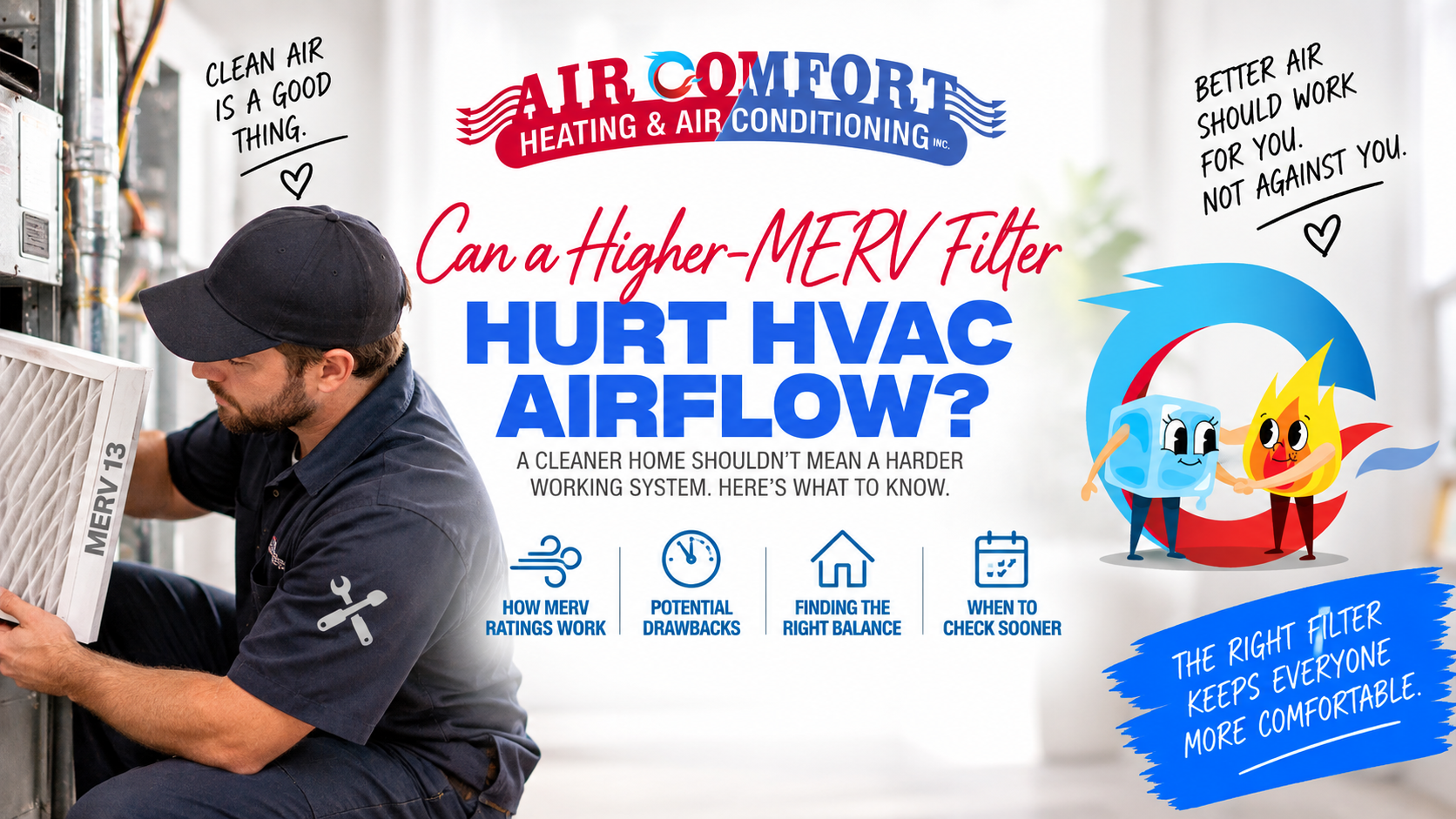
Can a Higher-MERV Filter Hurt HVAC Airflow?
You stand in the filter aisle.
Higher number must mean better.
So buy the biggest number, right?
Maybe.
The best filter is the one that improves filtration and works properly with your HVAC system.
What Does MERV Mean?
MERV stands for:
It is a rating system used to describe how effectively an air filter captures particles within specified size ranges.
So Why Not Install the Highest MERV Possible?
Filters create resistance as air passes through them.
The HVAC blower needs to overcome that resistance.
If a filter is too restrictive for the system, it can affect:
MERV Rating Is Not the Only Factor
Two filters with the same MERV rating may not create identical pressure drop.
Design matters.
A thicker filter with greater surface area may sometimes provide strong filtration with less resistance than a thin filter trying to accomplish the same thing.
Your Filter Cabinet Matters
Some homes have a basic 1-inch filter slot.
Others use:
The available surface area changes how filtration can be designed.
What About Wildfire Smoke?
Fine smoke particles are exactly why homeowners become interested in better filtration.
EPA also notes that an HVAC professional can help determine the highest-efficiency filter suitable for the system.
A higher-efficiency filter only helps if the HVAC system can continue moving the airflow it needs.
How Can You Tell if a Filter Is Too Restrictive?
Possible clues include:
Don't Forget to Replace It
A good filter becomes a bad airflow restriction if it is completely loaded with debris.
Replacement frequency depends on:
Do not rely entirely on the calendar.
Filtration Is a System Decision
If you want better indoor air quality, start with the question:
not:
Let's Match the Filter to the System
Air Comfort Heating & Air Conditioning helps homeowners throughout Anoka County, the North Metro and surrounding Minnesota communities improve HVAC filtration, understand MERV ratings and protect the airflow their heating and cooling equipment needs.
If indoor air quality is a priority, we can look at the filter, cabinet, airflow and system together instead of choosing based on one number on the package.
MERV & HVAC Filter Questions
Is MERV 13 good for wildfire smoke?
EPA currently recommends MERV 13 or higher where the HVAC system can accommodate the filter.
Can a high-MERV filter damage my HVAC system?
Excessive airflow restriction can create HVAC performance problems. Filter selection should account for the airflow requirements of the system.
Is a thicker filter better than a 1-inch filter?
Larger media filters can provide more filter surface area and may offer different airflow characteristics, but the correct setup depends on the HVAC system and filter cabinet.
Is Adding Refrigerant a Repair—or Just a Temporary Fix?
Your AC is not cooling.
Technician says refrigerant is low.
More refrigerant goes in.
Cold air returns.
Problem solved?
Maybe.
But not necessarily.
Refrigerant Is Supposed to Stay in the System
This is the key concept.
Residential air-conditioning refrigerant circulates through a closed system.
It is not consumed like fuel.
What Is a Refrigerant Recharge?
A technician can add refrigerant to bring the system back toward the required operating charge.
That may restore cooling.
But if refrigerant escaped through an unrepaired leak, the system may eventually lose it again.
When Might Adding Refrigerant Make Sense?
Situations vary.
For example:
What If Nobody Knows Where the Leak Is?
Ask what the plan is.
Depending on the equipment and situation, leak detection may be appropriate.
Why This Matters More on Older Equipment
Suppose an older AC has:
At some point, replacement may become more economical than repeated refrigeration-system work.
Ask These Questions
Before authorizing a significant refrigerant recharge, ask:
- 01 Why is the refrigerant low?
- 02 Do we know where it is leaking?
- 03 Can the leak be repaired?
- 04 What would leak repair cost?
- 05 How much refrigerant is being added?
- 06 What happens if it leaks again?
- 07 What condition is the rest of the AC in?
Don't Confuse Cold Air With a Permanent Repair
Restored cooling is great.
But if the leak remains, the underlying issue remains.
Let's Understand Whether You're Buying a Recharge or a Repair
Air Comfort Heating & Air Conditioning helps homeowners throughout Anoka County, the North Metro and surrounding Minnesota communities diagnose low refrigerant, AC leaks, frozen coils and refrigeration-system problems.
Adding refrigerant may restore cooling. The next question is whether the reason it was lost has also been addressed.
Refrigerant Recharge Questions
Does adding refrigerant fix an AC leak?
No. Adding refrigerant restores the system charge but does not physically repair the source of a leak.
How often should an AC need refrigerant?
Routine annual refrigerant additions are not normal for a properly sealed refrigeration system.
Should I repair a refrigerant leak on an old AC?
That depends on the leak location, repair cost, refrigerant type, equipment age and overall condition of the system.
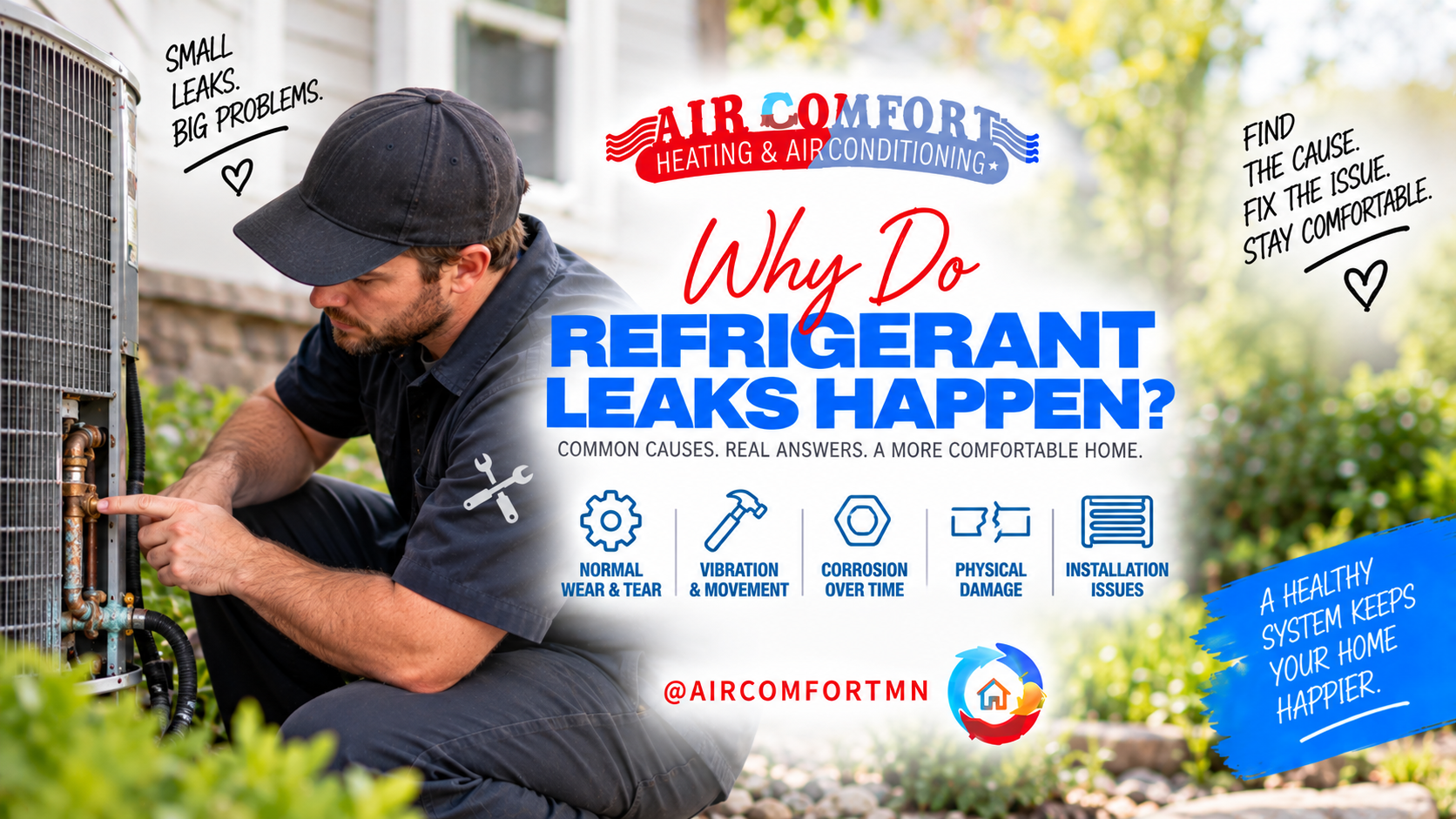
Why Do Refrigerant Leaks Happen?
Your AC is “low on refrigerant.”
That phrase makes it sound like the system simply ran out.
Like gasoline.
It doesn't work that way.
If refrigerant is missing, there is usually a reason worth understanding.
Refrigerant Does Not Get Burned Up
An air conditioner circulates refrigerant through the system repeatedly.
It absorbs and releases heat as it changes pressure and state.
So an air conditioner should not require a yearly “refrigerant refill” as routine maintenance.
Where Can Leaks Develop?
Refrigerant leaks can potentially occur at:
Does Equipment Age Matter?
Older equipment has experienced:
That can increase the likelihood of developing leaks.
Newer systems can leak too if a component or installation has a defect.
What Are the Signs?
Possible refrigerant-related symptoms include:
Can You Smell a Refrigerant Leak?
Do not rely on smell as your primary diagnostic tool.
Why Not Just Add More?
Sometimes refrigerant needs to be added as part of a proper repair.
But repeatedly adding refrigerant without addressing the leak can become expensive and temporary.
Eventually you need to discuss the nail.
Can Every Leak Be Repaired?
Not always economically.
A repair decision depends on:
R-410A Systems Can Still Be Serviced
Homeowners with existing R-410A systems should not assume a leak automatically means replacement simply because newer equipment uses different refrigerants.
Whether a repair makes financial sense depends on the actual equipment, the failed component, the leak location and the overall system condition.
Leak First, Decision Second
If your system is low on refrigerant, start by understanding why.
Then compare:
Let's Find Out Why Before Simply Adding More
Air Comfort Heating & Air Conditioning helps homeowners throughout Anoka County, the North Metro and surrounding Minnesota communities diagnose refrigerant loss, frozen coils, poor cooling and refrigeration-system problems.
If the system is low on refrigerant, the useful next question is not simply how much to add. It is why the charge is low and what repair makes sense for the actual equipment.
AC Refrigerant Questions
Does AC refrigerant run out over time?
Not under normal operation. The refrigeration circuit is intended to remain sealed and circulate the refrigerant repeatedly.
Does low refrigerant always mean there is a leak?
Loss of refrigerant means the charge is not where it should be, and the reason should be investigated rather than treated as routine consumption.
Can an AC refrigerant leak make the coil freeze?
Refrigeration problems can contribute to evaporator-coil freezing, although freezing can also have other causes such as inadequate airflow.
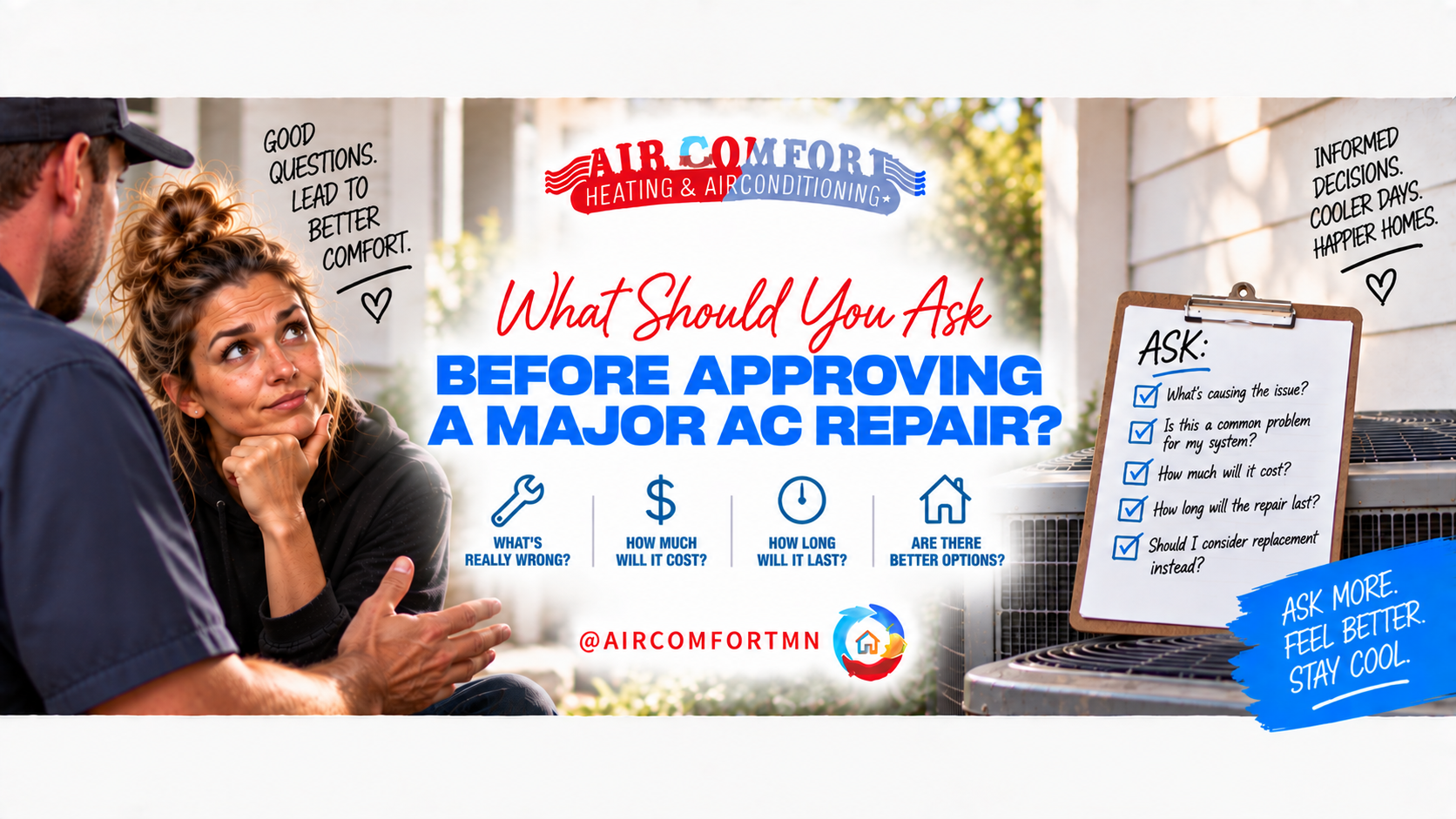
What Should You Ask Before Approving a Major AC Repair?
Your technician says the AC needs an expensive repair.
You now have two bad options:
Before making the decision, slow the conversation down enough to understand what you are buying.
What Exactly Failed?
You deserve a specific answer.
Not:
“The AC is bad.”
What Does This Repair Actually Fix?
Will the repair restore normal system operation?
Or is it a temporary measure addressing only one portion of a larger problem?
What Condition Is the Rest of the System In?
A major repair makes more sense when the remaining equipment appears healthy.
Ask about:
Nobody can guarantee the future.
Is Anything Still Under Warranty?
Before approving a large repair, check for:
What Happens if I Don't Repair It Today?
This is one of the most useful homeowner questions.
How Much Would Replacement Cost?
For major repairs, knowing the replacement option gives you a useful reference point.
What does it cost and what does it solve?
What does it cost and what changes?
What Else Would Replacement Change?
Would replacement improve:
Understand the benefit.
Is This the First Major Repair?
Repair history matters.
Would You Repair This if It Were Your House?
The technician's answer should still include context.
A technician and a homeowner may have different:
Can I Have the Recommendation in Writing?
Yes.
A written diagnosis and estimate helps you:
Good HVAC Decisions Should Survive Questions
If asking questions makes the sales process fall apart, that is useful information.
Homeowners should feel comfortable asking:
Air Comfort wants homeowners to understand what failed, what the recommended repair does, what alternatives exist and what tradeoffs come with each path.
Ask the Questions Before You Authorize the Work
Air Comfort Heating & Air Conditioning helps homeowners throughout Anoka County, the North Metro and surrounding Minnesota communities understand major AC repairs, replacement options, equipment condition and the tradeoffs between them.
If you received a major repair recommendation and still do not understand what failed, what the repair solves or what your other options are, those are questions worth answering before making the decision.
Major AC Repair Questions
Should I get a second opinion on an expensive AC repair?
For significant repairs or unexpected replacement recommendations, a second opinion can provide useful additional context.
Can I ask to see what failed?
Yes. Depending on the issue, technicians may be able to show the damaged component, test readings or other findings that support the diagnosis.
Should an HVAC estimate be written?
Major repairs and replacements should be clearly documented so you can understand the scope, price and recommendation.